
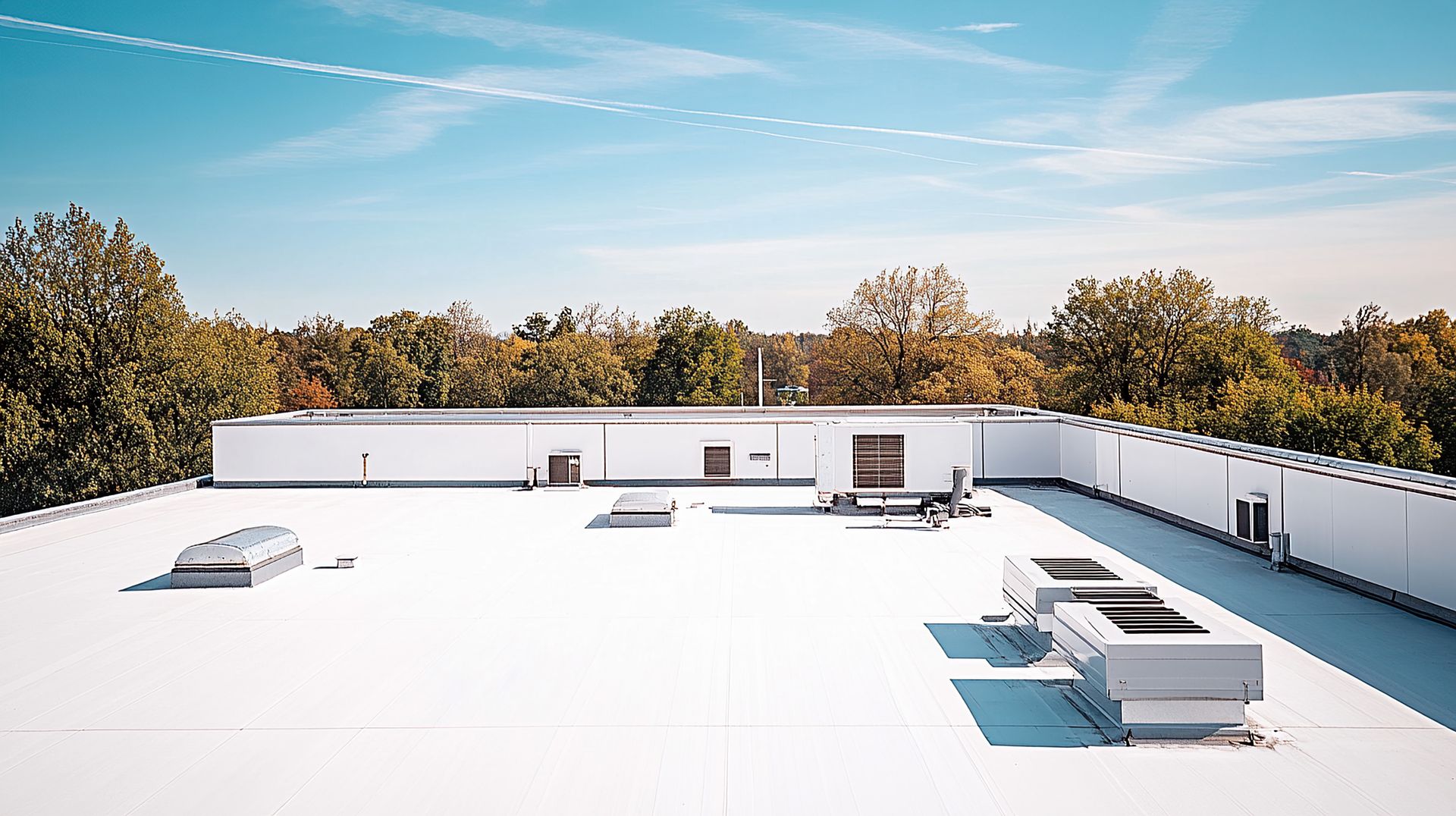
A 30,000 square foot warehouse owner in Wyoming called us last spring after getting quoted $180,000 to tear off his EPDM roof. We moisture-mapped it the next morning. Roughly 85 percent of the roof was dry and structurally sound. He paid a fraction of the tear-off quote, his tenants never moved out, and the roof carries a 20-year warranty.
That story is not unusual. Most commercial flat roofs in West Michigan that get quoted for tear-off do not actually need one. This guide walks through how to tell the difference — and what restoration costs, how long it lasts, and why most building owners do not have to shut down operations to get a roof project done.
Why Tear-Off Quotes Get So High
A commercial tear-off includes more than the new membrane. The quote you get usually covers:
- ◆Removal and disposal of the existing roof — often 10,000 to 50,000 pounds of material per job, hauled to a landfill at commercial dump rates.
- ◆Insulation replacement. Commercial code in Michigan now requires R-30 minimum on conditioned buildings. Older roofs almost never meet that spec, so a tear-off triggers a full insulation upgrade.
- ◆New membrane plus full installation labor. TPO, EPDM, or modified bitumen at current prices, plus the crew time to weld seams and detail every penetration.
- ◆Business disruption. Tear-off opens the deck to weather. Tenants relocate. Inventory gets covered or moved. That cost rarely shows up on the contractor invoice but it lands on the building owner.
Restoration skips most of those line items. The existing roof stays in place. Damaged sections get cut out and replaced. Everything else gets sealed under an Andek elastomeric coating system. Same waterproof result. Roughly half the cost.
How Moisture Mapping Decides
Restoration only works if the roof is mostly dry. To know that for sure, we run an infrared moisture map across the entire surface. The scan picks up temperature differentials caused by water trapped under the membrane — wet insulation holds heat differently than dry insulation, and the camera sees it.
The output is a marked-up map of the roof showing exactly where water has infiltrated. Three things come out of that map:
- ◆An honest restoration vs. replacement call. If 70 to 90 percent of the roof is dry, restoration is the right answer. If saturation is widespread or the deck is compromised, we tell you to tear it off — and we do not bid that job, because tear-off is not what we do.
- ◆A real scope of repair. You see exactly which areas need to be cut out and replaced before coating. No guesswork, no padding the bid for unknown damage.
- ◆Documentation for insurance or future claims. The marked-up moisture map plus drone aerials become part of your building file. If a storm damages the roof later, we already have a baseline.
The moisture map is free for any commercial roof in West Michigan. You get the report whether or not you hire us, and there is no charge if you walk away after seeing it.
What an Andek Restoration Actually Buys You
We use the Andek POLAROOF and elastomeric coating system on commercial flat roofs. The system is the same one specified on JFK Airport, NASA facilities, and the Pentagon — buildings where re-roofing is not a casual undertaking and the engineering standards are high.
On a West Michigan commercial roof, the system delivers:
- ◆20-year manufacturer warranty when applied per spec by a certified contractor.
- ◆Reflectivity that lowers cooling costs. The white finish reflects roughly 85 percent of solar heat. In a Michigan summer, the difference shows up on the building's cooling bill within the first season.
- ◆Seamless waterproofing. Coatings cure into a continuous monolithic membrane — no seams, no fasteners, no welded laps that fail with thermal cycling.
- ◆Compatibility with most existing systems. TPO, EPDM, PVC, modified bitumen, built-up, and metal roofs all accept the coating with the right primer.
The Wyoming Warehouse, by the Numbers
The 30,000 square foot warehouse from the opening paragraph — here is what the project actually looked like.
- Tear-off quote: $180,000 from a national contractor.
- Moisture map result: 85 percent dry. Wet sections concentrated around two roof drains and one HVAC penetration.
- Restoration scope: Cut and replace ~4,500 sq ft of wet EPDM and saturated insulation. Re-flash both drains and the HVAC curb. Apply the full Andek POLAROOF coating system across the entire roof.
- Final cost: Roughly 60 percent less than the tear-off quote, with a 20-year warranty.
- Downtime: Zero. Tenants stayed in the building. Forklifts kept running.
That math is not unique to that building. Most commercial roofs in West Michigan land in the same neighborhood once the moisture map comes back.
When Restoration Is the Wrong Answer
Restoration is not a fit for every roof. We tell building owners up front when tear-off is the right call:
- ◆The structural deck is rotted or compromised. Coating over a failing deck is throwing money at a problem that will come back.
- ◆Saturation covers more than 30 to 40 percent of the roof. Past that point, the cut-and-replace work approaches the cost of full replacement and the warranty math stops making sense.
- ◆Multiple failed coating layers are already on the roof. New coatings need a sound substrate to bond to. If the existing coatings have failed adhesion, they have to come off first — and at that point, tear-off is usually cheaper.
Frequently Asked Questions
How do I know if my flat roof can be restored instead of replaced?
The deck has to be sound. If the underlying structure is rotted or saturated through and through, restoration will not work. We start with a free moisture map — an infrared scan that pinpoints which sections of the roof have water intrusion. In most cases, 70 to 90 percent of the roof is dry and structurally fine, and only the wet sections need to be cut out and replaced. The rest gets sealed with an Andek elastomeric coating system. If the moisture map shows widespread saturation, we will tell you straight that tear-off is the right call.
What does a commercial flat roof restoration actually cost compared to tear-off?
Restoration runs roughly 50 to 70 percent less than a full tear-off and replacement. A 30,000 square foot warehouse roof that gets quoted at $180,000 to tear off and replace will typically restore in the $60,000 to $90,000 range, depending on how much wet membrane needs to be cut out and how many layers of coating the system calls for. The exact number comes off the moisture map — we charge for repairing what is actually damaged, not for redoing the whole roof.
How long does a restored commercial roof last?
Andek's POLAROOF and elastomeric coating systems carry a 20-year manufacturer warranty when applied per spec. In practice, we see restored roofs hold up well past that mark in West Michigan's climate as long as the building owner does basic annual maintenance — clearing drains, inspecting flashings, addressing punctures from HVAC service crews. The same products are on JFK Airport, NASA facilities, and the Pentagon, where they have been performing for decades.
Will my business have to shut down during the project?
No. That is one of the main reasons commercial owners pick restoration. The work happens overhead — coatings get sprayed and rolled out from the roof itself. Your tenants, employees, and customers stay in the building. There is no removal of debris, no exposed deck, and no weather-dependent demolition window. Most jobs run weekdays during business hours without anyone inside the building noticing.
What types of commercial roofs can be restored?
Most low-slope and flat roofs can be restored: TPO, EPDM, PVC, modified bitumen, built-up tar-and-gravel, and metal. The Andek system is compatible with all of them. The two cases where restoration does not work are roofs with structural deck failure underneath and roofs with multiple existing coating layers that have failed adhesion. We catch both of those during the moisture map and inspection.
Do you handle commercial insurance claims for storm damage?
Yes. Commercial storm and hail claims work the same way residential ones do — proper documentation, an adjuster meeting on the roof, and supplements for what gets missed. Matt has a storm restoration background and walks the roof with the adjuster on every commercial claim. We also document with drone footage and infrared scans, which carries more weight in commercial claim files than ground photos do.
Free Moisture Map and Inspection
If you own or manage a commercial building in West Michigan and you have been quoted for a tear-off — or you suspect your flat roof is failing — get a moisture map before you sign anything. The scan, the report, and the consult are free.
Call or text Matt directly at (616) 256-0831, or request a moisture map through our commercial roofing page or the general contact page.
Serving commercial property owners and facility managers in Grand Rapids, Jenison, Holland, Hudsonville, Wyoming, Grandville, Muskegon, Kalamazoo, Zeeland, and across West Michigan.