
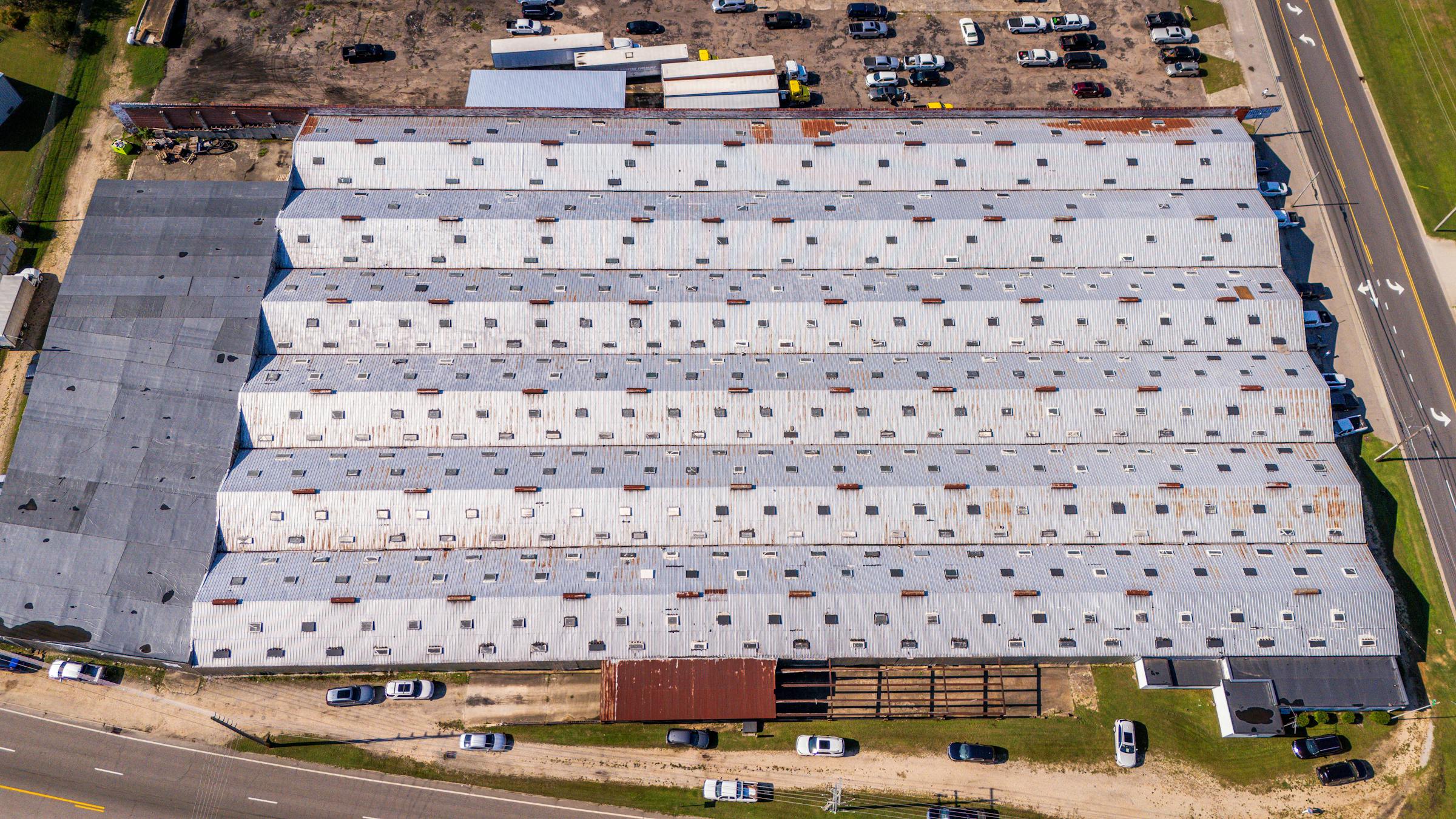
Ask a commercial property owner what kind of roof is on their building and most of them cannot tell you. That is not a knock — the roof is the one major building system nobody looks at until water is coming through a ceiling tile. But the membrane up there decides how it ages, how it gets repaired, what the warranty covers, and whether a contractor who quotes you a tear-off is right or just selling the biggest job they can.
There are six roof systems you will run into on a low-slope commercial building in West Michigan. Here is what each one is, how to recognize it, how it fails, and the part most owners do not hear from a replacement salesman — almost all of them can be restored instead of torn off.
The Six Roof Systems on a West Michigan Commercial Building
EPDM — Black Rubber Single-Ply
The black rubber roof you have seen on warehouses and strip centers since the 1970s. EPDM comes in wide rolls that are glued, ballasted with stone, or held down by fastener plates, with the seams bonded by adhesive or seam tape. It handles UV well and lasts 20 to 25 years. It fails by shrinking — the sheet tightens over time and pulls at the seams and the flashings around curbs and walls. How to spot it: if your flat roof is black and the seams are taped or glued rather than melted together, it is EPDM.
TPO — White Heat-Welded Single-Ply
The white membrane that has been the default on new commercial construction for the last 20 years. TPO comes in rolls like EPDM, but the seams are heat-welded into one continuous melted bead instead of taped. The white surface reflects sunlight, which lowers cooling costs and slows aging. It runs 15 to 20 years and fails by thinning at the top layer and by welds opening up at the seams, usually because the original welder ran the iron too hot or too cold. How to spot it: white or light-gray rolls with seams that look melted together, not taped.
PVC — White Heat-Welded, Grease-Resistant
Looks a lot like TPO — white, single-ply, heat-welded seams — but the chemistry is built to shrug off animal fats, oils, and chemical exhaust. You find PVC on restaurants, food plants, and manufacturing buildings, especially around kitchen and process exhaust fans. It lasts 20 to 25 years and ages by losing plasticizers, which makes the membrane brittle and prone to cracking, particularly at corners and around penetrations. How to spot it: white welded membrane on a building that cooks or processes food, often discolored near the grease ducts.
Modified Bitumen — Rolled Asphalt Sheets
Asphalt-based roofing in rolled sheets, either torch-applied or self-adhered, often with a mineral-granule surface that makes it look like rolled shingle. Common on smaller commercial buildings and as a cap sheet over older built-up roofs. It lasts 15 to 20 years and fails by losing its granules — which leaves the asphalt exposed to UV — and by the seams splitting as the material gets brittle in the cold. How to spot it: a surface that looks like asphalt shingle unrolled flat, with visible granules and overlapping seams every three feet or so.
Built-Up Roof (BUR) — Tar and Gravel
The old standard before single-ply took over: layers of asphalt and roofing felt built up on site, topped with loose gravel ballast. You still see it on older office buildings, schools, and municipal properties. Built right, it lasts 20 to 30 years. It ages by alligatoring — the surface cracks into a scaled pattern — by blistering between the layers, and by gravel migrating away from high spots and into the drains. How to spot it: a loose gravel surface you can scuff with your boot, usually on a building put up before the 1990s.
Metal Panel — Low-Slope Standing Seam or R-Panel
Steel or aluminum panels on a shallow slope, either standing seam (hidden clips, raised ribs) or exposed-fastener R-panel (rows of visible screws). Common on pole barns, agricultural buildings, and metal-frame industrial buildings. The panels themselves last decades. The roof fails at the connections — the rubber washers under exposed fasteners dry out and leak, the panel laps open up as the metal expands and contracts, and rust takes hold at the seams, the eaves, and around every penetration. How to spot it: visible ribs or panel lines and, on R-panel, neat rows of screw heads.
Why Knowing Your Roof Type Actually Matters
- ◆Repairs have to match. You cannot patch a TPO roof with EPDM materials, and you cannot heat-weld a patch onto a rubber membrane that does not melt. A crew that shows up with the wrong material either makes a repair that fails in a season or makes the problem worse. Knowing the system means the repair is compatible from the start.
- ◆Warranties are membrane-specific. Manufacturer warranties on single-ply roofs spell out which repair materials and which contractors keep the coverage intact — and most of them are voided by ponding water or by a repair done with the wrong product. If you do not know what is up there, you do not know what voids your warranty.
- ◆Budgeting depends on it. A 14-year-old TPO roof and a 14-year-old built-up roof are at very different points in their service life. Knowing the type and the install year is the difference between planning a roof project on your schedule and getting surprised by it after a storm.
- ◆Insurance claims need it documented. When wind or hail damages a commercial roof, the adjuster wants to know the system, its age, and its pre-loss condition. A roof survey that names the membrane and maps the damage gives you the paperwork to back up the claim instead of arguing it after the fact.
How to Find Out What You Have
You do not have to climb up there yourself. Start with the paperwork:
- ◆The construction documents. If the building was built or re-roofed while you owned it, the roofing spec section of the closing binder names the system, the manufacturer, and the warranty term.
- ◆The last roofing invoice. Any repair or recoat in the file usually states what was worked on. So does the warranty certificate, if one was issued.
- ◆The roof itself. Membrane manufacturers stamp the product near drains, at curb flashings, and inside mechanical wells. A maintenance tech or roofer can read it off in two minutes.
If the paperwork is a dead end — and on buildings that have changed hands a few times, it usually is — a roof survey settles it. A walkthrough identifies the membrane, the install era, and the condition, and an infrared moisture scan run after sundown maps exactly where water has gotten into the insulation. That tells you not just what you have, but how much of it is still good.
The Part the Tear-Off Salesman Skips
Every one of these systems — EPDM, TPO, PVC, modified bitumen, built-up, and metal — can be restored with an elastomeric coating system instead of ripped off and replaced. We use Andek, the same coatings that protect roofs at JFK Airport, NASA facilities, and the Pentagon.
The prep is specific to the substrate — a metal roof gets its fasteners checked and its rust treated, a gravel built-up roof gets the loose stone removed and the surface flood-coated, a single-ply roof gets its seams reinforced. But once the surface is ready, the coating goes on as one seamless, reflective, waterproof layer over the whole roof. No seams for water to attack. No tear-off, no dumpsters, no business shut down.
Restoration runs roughly 50 to 70 percent less than a full tear-off and carries a 20-year warranty. The one thing it cannot fix is a structural deck that has already rotted through — and that is exactly what the moisture map tells you before a dollar is spent. On most roofs we scan, the deck is sound and 80 to 90 percent of the insulation is dry. Those roofs do not need a tear-off. They need a coating and a contractor who will tell them so.
What to Do Next
Pull the roofing section out of your building file. If you find the system and the install year, you are ahead of most owners. If you do not — or if the roof is leaking, ponding, or just old enough that you are starting to wonder — get a roof survey and a moisture map before you take a single replacement bid.
Platinum Roofing Restoration does that survey free for commercial buildings across Grand Rapids, Jenison, Wyoming, Holland, Muskegon, Kalamazoo, and the rest of West Michigan. You get the membrane identified, the condition documented, and the moisture map to keep — whether you hire us or not.
Frequently Asked Questions
How do I tell the difference between TPO and EPDM?
Color and seam method. EPDM is almost always black — the older single-ply rubber roof — and its seams are bonded with adhesive or seam tape. TPO is white, light gray, or tan, and its seams are heat-welded into a continuous melted bead, not a taped strip. If you can see rows of fastener plates pressing the membrane down, both are mechanically attached single-ply. The fastest tell from the ground: a black flat roof is almost always EPDM, and a bright white one is TPO or PVC.
Does the type of roof I have change whether I need a full tear-off?
Less than the condition of the structural deck underneath. EPDM, TPO, PVC, modified bitumen, built-up, and metal can all be restored with an elastomeric coating system as long as the deck and most of the insulation are sound. A moisture map shows what percentage of the insulation is actually saturated. On most commercial roofs that get quoted for replacement, 80 to 90 percent of the deck is dry — which means restoration, not tear-off, regardless of membrane type.
Can you coat a metal roof, or does that only work on rubber roofs?
Metal low-slope roofs are good candidates for restoration coatings. The failure points on a metal roof are the fastener gaskets, the panel laps, and rust at the seams and penetrations — all of which a coating system seals once the surface is cleaned, rust-treated, and primed. Andek systems are applied over metal, single-ply, and built-up roofs alike. The prep work is different for each substrate, but the result is the same: a seamless, waterproof, reflective surface with a long warranty.
My roof is 18 years old. Is it automatically time to replace it?
Age is a flag, not a verdict. A single-ply membrane rated for 20 years that has been kept clean, with working drains and no chronic ponding, usually has life left in it. A 12-year-old roof with a clogged drain and standing water can be in worse shape than a well-maintained 20-year-old one. The only way to know is a roof survey plus an infrared moisture scan — it tells you the condition, not just the age, and it costs you nothing.
Where can I find out what membrane is on my building?
Three places. First, the original construction documents or building closing binder — the roofing spec section names the system. Second, your most recent roofing invoice or warranty certificate. Third, the rooftop itself — manufacturers stamp the membrane near drains, curbs, and mechanical wells. If none of those turns up an answer, a roof survey identifies it on the spot and gives you the condition report at the same time. Platinum Roofing runs that survey free for commercial buildings across West Michigan.
Schedule a Free Roof Survey + Moisture Map
Platinum Roofing Restoration is based in Jenison and serves commercial property owners across West Michigan. We will identify your roof system, document its condition, run an infrared moisture scan, and hand you the report. No obligation, no pressure — just a straight answer about what you have and what it needs. Call or text Matt at (616) 256-0831.
Serving Grand Rapids, Jenison, Holland, Hudsonville, Muskegon, Kalamazoo, Wyoming, Grandville, Zeeland, and all of West Michigan.