
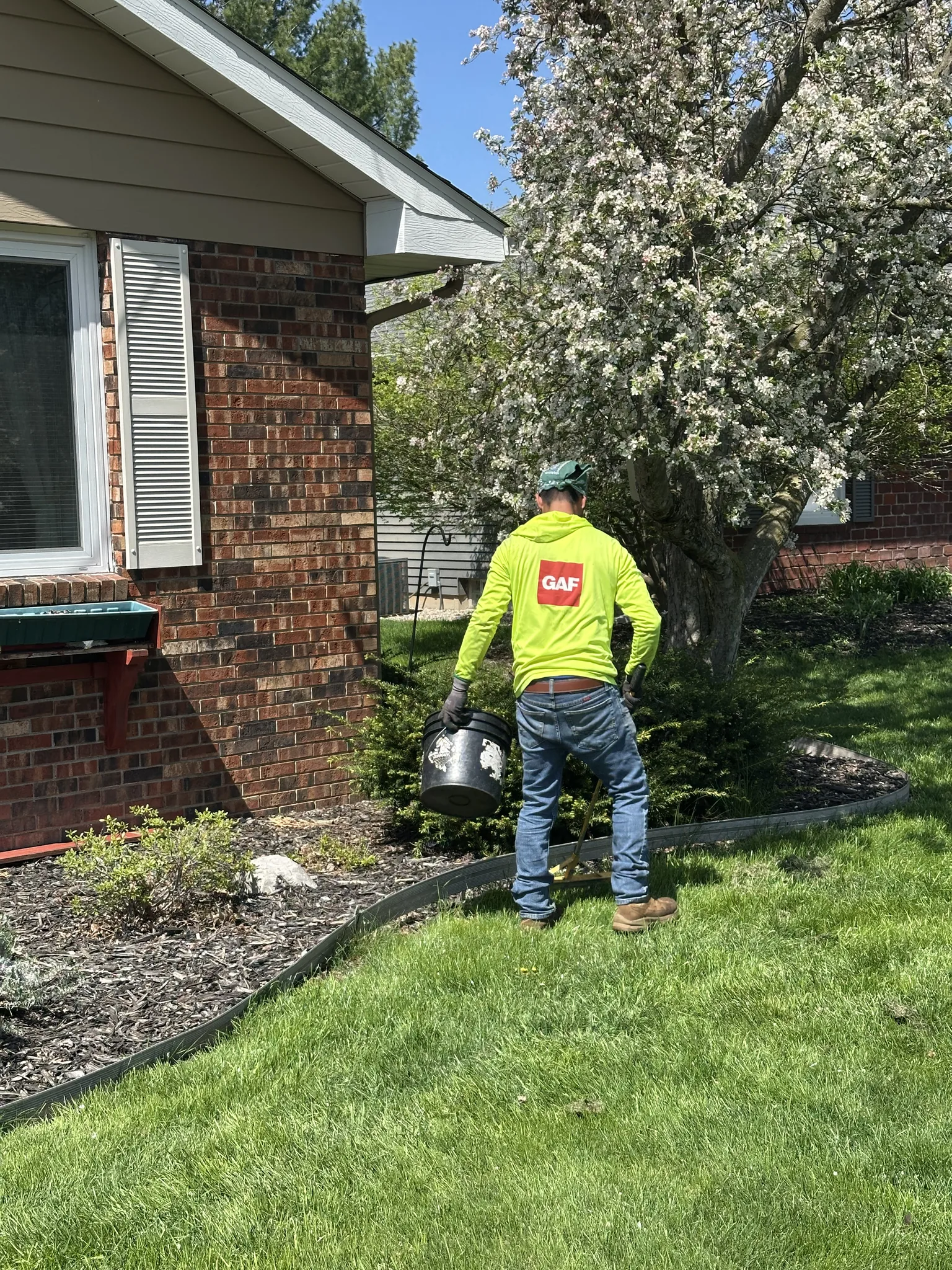
The week after a hail storm rolls through West Michigan, the doorbells start. A friendly crew in an unmarked truck, a clipboard, and a pitch that is already at a full replacement before anyone has set a ladder against the house. They can start tomorrow. They just need a deposit today.
Some of those crews are legitimate. Many are out-of-state storm-chasers who will be three states away by the time the first leak shows up, taking the warranty they promised with them. The roof is the single most expensive system on your house, and the value of the work depends entirely on whether the company that did it still exists when something goes wrong. Here is how to tell the difference before you sign.
The Out-of-Town Storm-Chaser Playbook
Storm-chasers run a recognizable pattern. None of these on its own proves bad intent — but when you see several together, you are almost certainly talking to a crew that will not be here next year.
The Unsolicited Door-Knock Right After a Storm
A crew that found your neighborhood because of the weather, not because of a referral, has no relationship to protect. The whole model depends on volume and speed before they move to the next storm market. A local contractor’s pipeline comes from repeat customers and word of mouth, not from canvassing a subdivision the day the radar clears.
A Full-Replacement Quote From the Driveway
A diagnosis with no inspection is a sales pitch. Real damage assessment means walking every slope, photographing what gets flagged, and checking the deck — not eyeballing the roof from the curb and naming a number. If the replacement conversation starts before anyone has been on the roof, the number is built on the size of the sale, not the condition of the roof.
Pressure to Sign and a Large Cash Deposit
“This price is only good today” and “I need half down to lock in materials” are the two oldest lines in the book. Established suppliers extend credit to local contractors, so a big upfront deposit is rarely about materials — it is about getting your money before you have time to check them out. The urgency is manufactured for the same reason.
An Offer to “Waive” Your Insurance Deductible
On a covered storm claim you generally owe only your deductible. A contractor who offers to eat it, rebate it, or bury it in the paperwork is committing insurance fraud under Michigan law — and dragging you into it. A contractor willing to defraud the carrier on day one is not the one you want standing behind a 25-year warranty.
No Verifiable Local Address
A magnetic sign on a rented truck, a cell number with an out-of-state area code, and a P.O. box are not a local business. Ask where the office is. Ask how long they have worked this county. The answers — and how comfortable they are giving them — tell you most of what you need to know.
The Seven Checks Before You Sign
Whether the contractor knocked on your door or you found them yourself, run these seven checks before a single shingle is ordered. Each one takes a few minutes, and together they rule out almost every bad actor in the market.
- ◆A Michigan license you can verify. Residential roofing in Michigan requires a state license through LARA. Get the license number and look it up yourself — it is free and takes two minutes. An unlicensed install also voids most manufacturer warranties.
- ◆Proof of insurance — both kinds. Ask for a certificate showing general liability and workers’ compensation. If an uninsured worker is hurt on your property, the liability can land on you. Call the agent on the certificate to confirm it is current, not expired.
- ◆Manufacturer certification. A GAF-certified contractor has been vetted by the manufacturer and can register enhanced system warranties that cover both materials and workmanship for far longer than a standard warranty. Non-certified crews cannot offer that coverage at all.
- ◆A real local track record. A physical address in or near your county, a phone a person answers, and reviews that span years — not a burst posted in a single month. Drive past a recent local job if you can.
- ◆A written, itemized scope. The contract should spell out tear-off vs. layover, the exact shingle and underlayment products, ice-and-water shield coverage, flashing and ventilation details, cleanup, and the total price. “Replace roof — $X” on a single line is not a scope; it is a blank check.
- ◆A workmanship warranty you can collect on. The manufacturer warranty covers the shingles; the contractor’s workmanship warranty covers the install. The second one is only worth anything if the company is still around to honor it — which is exactly why local matters.
- ◆A deposit structure that makes sense. Reasonable progress payments tied to milestones are normal; a large cash deposit demanded before any material arrives is not. On an insurance job, you should generally pay only your deductible.
Why “Local” Actually Matters in West Michigan
“Local” is not a marketing word — it is the thing that makes the warranty real. A roof installed today might not show a workmanship problem until the third or fourth freeze-thaw cycle drives water under a poorly seated flashing detail. When that happens, the only warranty worth anything is one backed by a company you can still call. A crew that worked your subdivision for three weeks in May and left is not answering that phone in February.
Local also means the contractor knows what West Michigan actually does to a roof — lake-effect ice loading at the eaves, the freeze-thaw cycling that cracks sealant, the wind exposure on open lots. That shows up in how they detail the ice-and-water shield, how they spec ventilation, and which products they reach for. A crew that installs the same roof in Texas and Michigan is not building for our winters.
Questions to Ask on the First Visit
You do not need to be a roofer to vet one. A handful of direct questions, asked on the first visit, separates the contractors who have nothing to hide from the ones who get vague:
- ◆What is your Michigan license number, and where is your office?
- ◆Can I see your liability and workers’ comp certificates?
- ◆Are you manufacturer-certified, and what warranty can you register?
- ◆Will you put the full scope and product list in writing before I sign?
- ◆Can you give me two or three recent local job addresses?
- ◆What does your workmanship warranty cover, and for how long?
How We Earn the Job at Platinum
Platinum Roofing Restoration is family-owned in West Michigan and has worked these neighborhoods since 1990. We are GAF Certified, licensed and insured in Michigan, and we register the enhanced system warranties that come with that certification. A residential inspection is free and runs about an hour: we walk every slope, photograph anything we flag, scan the field with infrared moisture equipment, and pull the storm history for your address. You get a written report and an itemized scope — repair or replacement, whichever the roof actually shows — before you are asked to commit to anything. If there is an open insurance claim, we meet your adjuster on site at no cost. And because we are here year-round, the workmanship warranty is backed by a phone number that still works in February.
Get a Free Roof Inspection With Moisture Mapping
GAF Certified · Family-owned in West Michigan since 1990 · Licensed and insured · We handle storm-damage insurance claims end-to-end and meet your adjuster on site at no cost.
Request Your Free InspectionFrequently Asked Questions
Do roofing contractors have to be licensed in Michigan?
Yes. Residential roofing work in Michigan requires a Residential Builder or Maintenance & Alteration Contractor license issued by the state's Department of Licensing and Regulatory Affairs (LARA). You can verify any contractor's license for free at the LARA license lookup before you sign anything. A crew that cannot give you a license number to check is a crew you should not put on your roof — an unlicensed installer also voids most shingle manufacturer warranties, so the 30-year coverage you think you are buying may not exist.
What is a storm-chaser, and why are they a problem?
A storm-chaser is an out-of-area crew that follows hail and wind events from state to state, sets up a temporary local presence, and works neighborhoods door-to-door for a few weeks before moving on. The work is often subcontracted to whoever is cheapest, the warranty is only as good as a company that no longer exists, and there is no one to call when a flashing detail leaks two winters later. They are not all dishonest — but even an honest storm-chaser cannot stand behind a 10-year workmanship warranty from 600 miles away.
What does GAF Certified actually mean, and why does it matter?
GAF certifies only a small percentage of roofing contractors in any market, and the certification requires proof of licensing, insurance, and a track record GAF reviews. The practical payoff is the warranty: a GAF-certified contractor can register enhanced system warranties that cover both the materials and the workmanship for far longer than a standard manufacturer warranty — coverage a non-certified installer simply cannot offer. It is also a standing signal that the manufacturer was willing to attach its name to the contractor's work.
Should I pay a deposit before the work starts?
Be cautious. A reputable West Michigan contractor does not need a large upfront deposit to buy materials — established suppliers extend them credit. A request for a big cash deposit before any material is on site is one of the most common storm-chaser patterns. On an insurance claim, you should generally only owe your deductible; if a contractor offers to 'waive' or 'eat' your deductible, that is insurance fraud in Michigan and a reason to walk away, not a discount.
How do I check a contractor's reviews and references in West Michigan?
Look for a physical local address, a phone number that a person answers, and a body of reviews that spans years rather than a burst of five-star reviews posted in a single month. Ask for two or three recent local job addresses you can drive past, and check that the business name on the contract matches the name on the license, the insurance certificate, and the truck. A contractor who has worked the same county for decades has a paper trail you can follow; a chaser does not.