
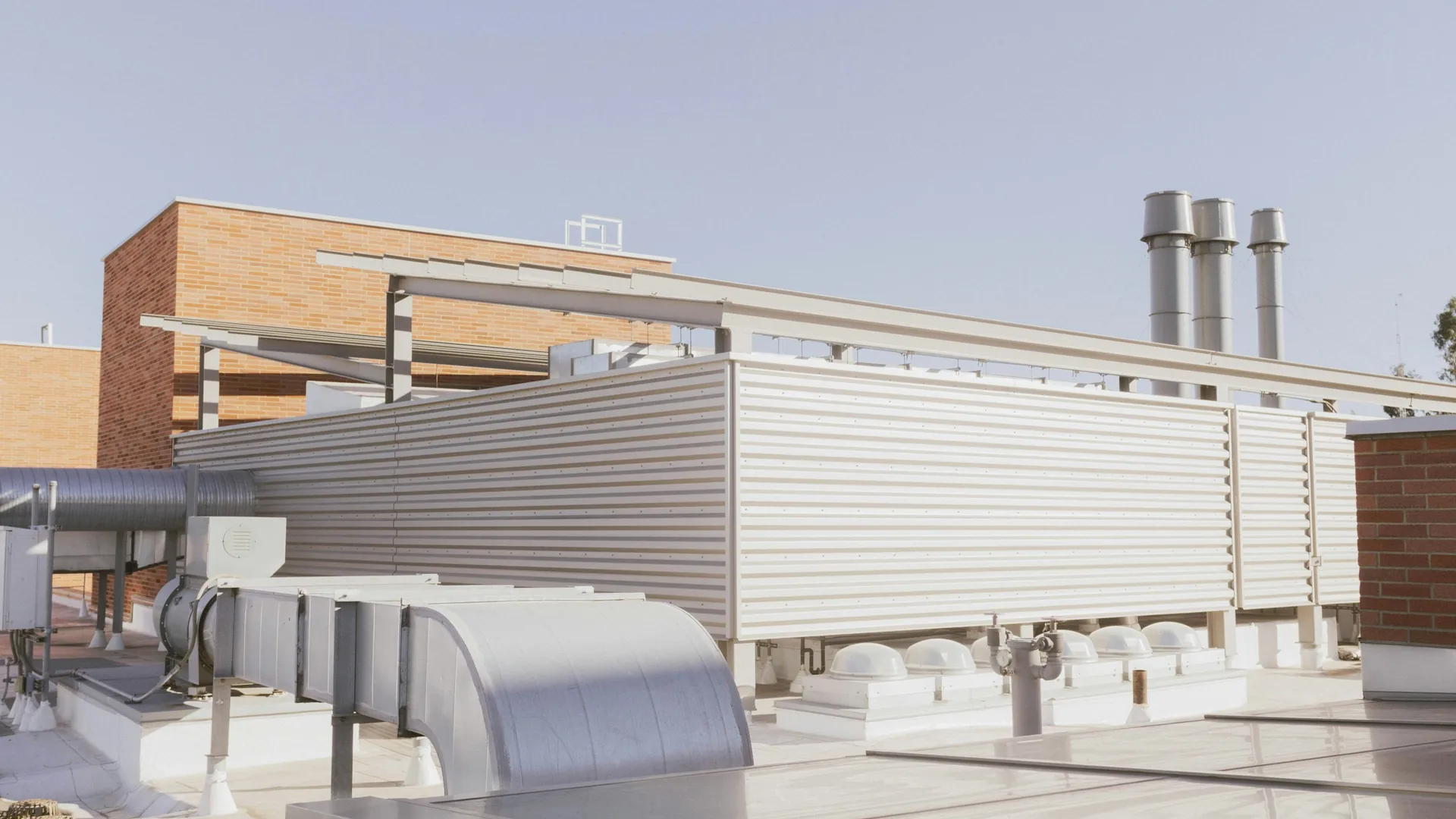
A commercial roof can have acres of uninterrupted membrane and still leak through a detail that fits inside a few square feet. HVAC curbs, exhaust fans, plumbing vents, gas lines, conduits, and ducts all pass through or sit above the waterproofing layer.
Each penetration forces the roof to turn up, wrap around a corner, seal to another material, or accommodate movement. Those transitions need more attention than the open field because water, foot traffic, and service work meet in the same place.
The Equipment Is Usually Not the Roof Detail
A large rooftop unit normally rests on a curb. The curb raises the equipment above the roof surface and creates a vertical wall that the membrane must climb. Flashing, counterflashing, corner patches, and termination details connect that wall to the surrounding roof.
Water found below an HVAC unit does not automatically mean the unit itself is leaking. The source may be a split curb corner, a loose metal cover, a puncture beside the service panel, a seam uphill, or condensate that discharges onto the roof. The inspection has to separate equipment problems from roofing problems before either trade starts replacing parts.
Six Common Leak Paths Around Rooftop Equipment
1. Split or lifted curb flashing
Membrane flashing turns from the horizontal roof onto the curb. Heat, cold, building movement, and repeated service access can stress that bend. A split may be small on the surface while water has already reached insulation below it.
2. Weak outside corners
Corners require cuts, folds, or reinforced patches. Gaps can form where materials bridge instead of lying tight, where a patch ends short, or where old sealant hides movement. Corners deserve a close hand check, not only a view from several feet away.
3. Loose counterflashing and exposed fasteners
Metal counterflashing protects the top of the membrane flashing. Bent panels, missing fasteners, open joints, and poorly placed screws can send water behind the assembly. A line of caulk across the face does not restore a loose mechanical connection.
4. Failed pipe boots or pitch pockets
Round pipes may use flexible boots or field-fabricated flashing. Clusters of irregular lines may pass through a pitch pocket filled with a pourable sealant. Cracked fill, separated edges, loose clamps, and added lines pushed through old details create direct water paths.
5. Punctures from tools and panels
HVAC technicians need room to remove panels and carry tools. Sharp corners, dropped screws, and heavy traffic can damage a membrane, especially when no walkway pads protect the service route. The puncture may sit beside the unit rather than beneath it.
6. Water held beside the curb
Equipment can interrupt drainage and create a slow area on the uphill side. Debris, a sagging substrate, or condensate can keep seams wet longer than the surrounding field. Our guide to ponding water on flat roofs explains why the drainage pattern belongs in the leak diagnosis.
The newest patch is not always the newest leak
Water can enter at a seam uphill, travel across the deck or insulation facer, and appear near an HVAC opening. Follow the path before adding material to the curb simply because it is close to the ceiling stain.
Why Service Work Changes the Roof
Rooftop equipment changes during the life of a building. A unit may be replaced, a line set rerouted, or a new conduit added. Even routine service moves panels and puts technicians on the same narrow path several times a year.
The roofing detail should be checked whenever equipment work touches the curb or penetrations. New lines should not be pushed through an old patch without a compatible flashing plan. Abandoned pipes should not be cut off and left as open pockets. Coordination between the roofer and mechanical contractor prevents the next service call from becoming the next leak call.
What a Useful Inspection Includes
Start inside. Note when the leak appears, what space sits above the stain, and whether it follows rain, snowmelt, or equipment operation. Check accessible deck, joists, insulation, and ceiling materials for the direction of staining.
On the roof, inspect the full drainage area around the equipment. The curb corners, counterflashing, seams, pipe boots, pitch pockets, fasteners, condensate route, walkway pads, and nearby drains all matter. Photograph each side of the unit so the repair scope can name the failed detail.
Infrared or other moisture mapping can help identify possible wet areas below the surface. That is especially useful when the visible split is small but the leak has been active for a long time. Read our roof moisture mapping guide for a closer look at what the assessment can show.
What a Lasting Repair Should Address
A sound repair removes loose patches and exposes enough of the detail to inspect the substrate. Wet insulation or damaged cover board is addressed where found. The curb or penetration is then rebuilt with materials compatible with the existing membrane and integrated into sound roofing on every side.
The scope should also correct the cause. That may mean securing counterflashing, adding walkway protection, rerouting condensate, rebuilding a pitch pocket, or coordinating a curb change with the HVAC contractor. Repeating the same patch while leaving the same movement or drainage problem usually buys little time.
When Restoration May Fit
An isolated dry penetration can often be repaired on its own. When the field membrane has broad weathering but the assembly remains a suitable restoration candidate, repaired curbs and penetrations may become part of a larger waterproofing scope.
Platinum uses Andek restoration systems on qualifying commercial roofs. The detail work comes first. A coating cannot replace wet insulation, secure loose metal, or bridge an active moving joint. Our guide to commercial roof restoration explains how focused repairs fit into a broader plan.
What the Repair Estimate Should Say
- 01Leak area. Which curb, vent, pipe, seam, or drainage area will be opened and inspected?
- 02Wet material. How will trapped moisture be checked, documented, and removed if confirmed?
- 03Compatible system. Which membrane, flashing, reinforcement, and termination materials are included?
- 04Coordination. Does the HVAC, plumbing, or electrical trade need to move or support anything before the roof repair?
- 05Final evidence. Will the contractor provide before, during, and after photos of the rebuilt detail?
Frequently Asked Questions
Why do commercial roofs leak around HVAC units?
The equipment often sits on a raised curb that interrupts the roof membrane. Leaks can develop where the membrane turns up the curb, at outside corners, beneath counterflashing, around fasteners, or where service work damages the surrounding roof. Condensate and nearby ponding can add more water to the area.
Can roof cement fix a leaking HVAC curb?
Roof cement may serve as a short temporary measure in some situations, but it does not identify wet insulation, loose flashing, split membrane, or movement at the curb. A lasting repair uses materials compatible with the existing roof system and rebuilds the failed transition rather than covering it with another surface patch.
How can a ceiling leak be traced to rooftop equipment?
The interior stain is compared with roof plans, deck direction, structural members, drains, and nearby penetrations. On the roof, the inspection checks seams, curb corners, pipe boots, pitch pockets, fasteners, condensate discharge, and signs of trapped moisture. Water can travel before it drips, so the stain is a clue rather than an exact map pin.
Should an HVAC contractor repair the roof flashing?
HVAC contractors service the equipment, while qualified roofing contractors should handle the roof membrane and flashing. The two trades need to coordinate when a unit, curb, line set, or duct is changed so the equipment work does not leave an unsupported or unsealed roof detail.
Can a leaking penetration be repaired without replacing the whole roof?
Often, yes. A focused repair may be appropriate when the surrounding membrane and insulation remain sound and the failure is limited to one curb, boot, seam, or penetration. Broad wet insulation, widespread seam failure, or an aging system may justify a larger restoration or replacement scope.
How does moisture mapping help with commercial roof leaks?
Moisture mapping helps identify areas where water may be trapped below the visible membrane. That information can separate a dry, repairable penetration from a larger wet area that requires insulation removal. Findings still need to be confirmed and interpreted with the roof assembly and site conditions in mind.
Inspect the Transition, Not Just the Stain
Rooftop equipment creates necessary openings in the roof system. A useful leak investigation identifies the exact failed transition, checks what is wet below it, and fixes the condition that caused the failure.
Platinum Roofing inspects commercial roofs across Grand Rapids, Jenison, Holland, Muskegon, Kalamazoo, and surrounding West Michigan communities. For a free commercial roof assessment, call or text (616) 256-0831 or send the building details through our contact form.