
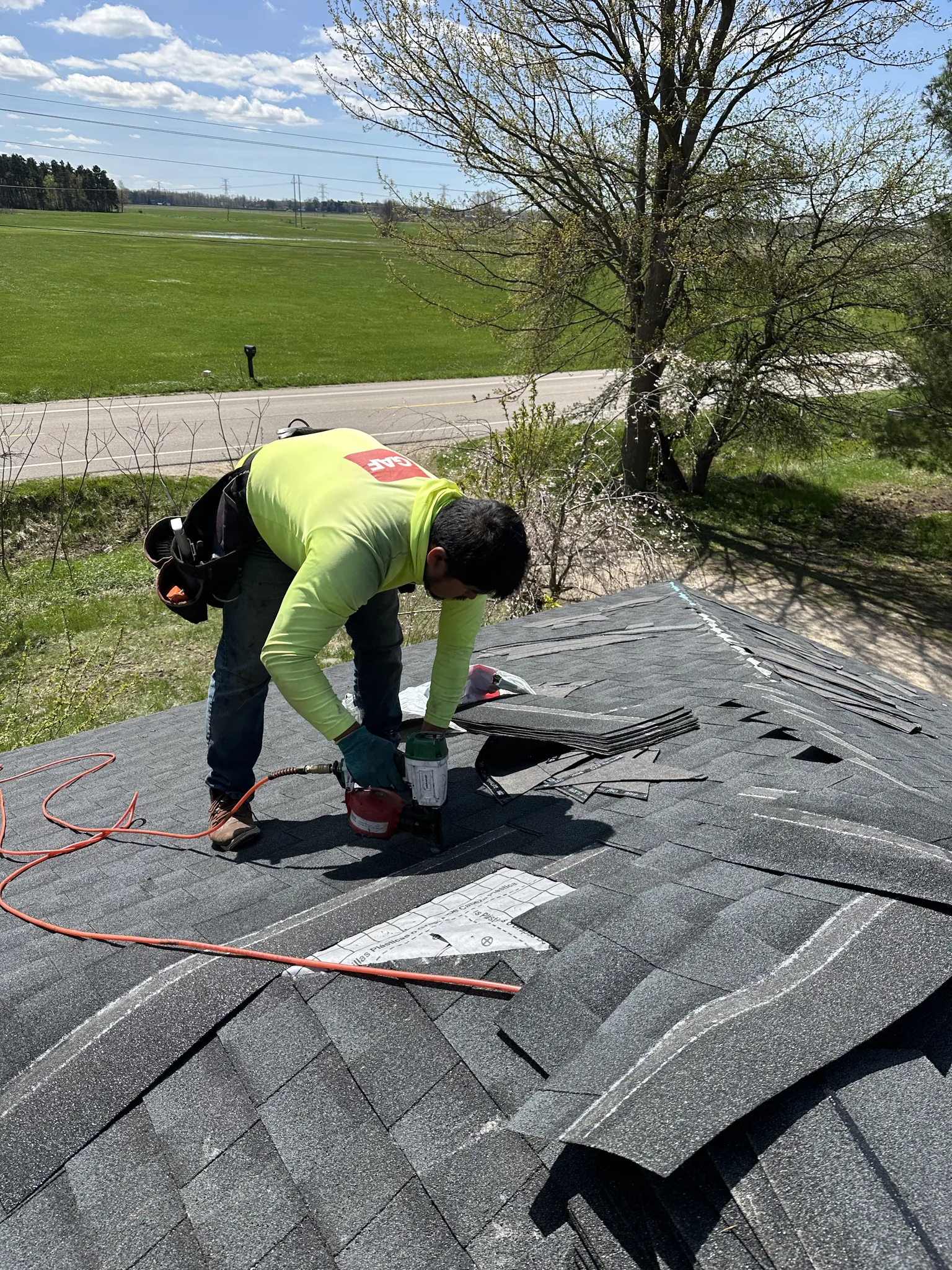
Get three quotes for the same West Michigan roof and the numbers can land thousands of dollars apart. Homeowners usually assume the gap is markup. It almost never is — shingles cost roughly the same for every contractor in Grand Rapids. The gap lives in the scope: what one estimate includes that another quietly leaves out.
A roof is a system, and the parts you never see — underlayment, ice and water barrier, flashing, ventilation — are what decide whether it lasts. Here is what each line item in a roof replacement estimate actually pays for, where the cheap quotes cut, and how to compare two bids so you are comparing the same job.
First Rule: A One-Line Quote Is a Blank Check
“Replace roof — $14,000” on a single line tells you the price and nothing else. It does not say whether the old shingles come off or get buried under new ones, whether the flashing is new or reused, what happens when the crew finds soft decking, or who hauls away three tons of debris. Every one of those questions has a cheap answer and a right answer, and a one-line quote lets the contractor pick the cheap one after you have signed.
An itemized scope is the single fastest way to separate a professional from a storm-chaser working your neighborhood. Insist on one before comparing prices at all.
The Line Items, One by One
A complete residential re-roof estimate in West Michigan should account for all of the following. The order varies; the contents should not.
- 01Tear-off down to the decking. Removing the old shingles, underlayment, and accessories down to bare wood. Michigan code allows shingling over one existing layer, and some low bids rely on it — a layover is cheaper today because it skips the tear-off labor and the dumpster. It also seals in whatever is wrong underneath and makes the next roof a double tear-off. The estimate should say the word “tear-off” explicitly.
- 02Decking inspection and repair terms. Nobody knows the condition of your roof deck until the shingles are off. What you can know up front is the price: a proper estimate commits to inspecting the decking and states a per-sheet price for replacing soft or rotted plywood. If decking is not mentioned, you will meet it later as a surprise invoice.
- 03Underlayment. The water-resistant layer between the decking and the shingles — the roof's second line of defense. Modern synthetic underlayment outperforms old asphalt felt in every way that matters here: it does not wrinkle when it gets damp and it does not tear in the wind mid-install. “Felt” on the line item is a cost cut; ask for synthetic by name.
- 04Ice and water barrier. A self-sealing membrane at the eaves, valleys, and around penetrations — the exact places lake-effect ice dams force meltwater under the shingle courses. Michigan code requires it at the eaves in our climate zone. The line item should say where it goes, because “included” at the eaves only is code-minimum, while eaves plus valleys plus penetrations is how a roof actually survives a West Michigan February.
- 05Drip edge and starter course. Metal drip edge directs runoff into the gutters instead of behind the fascia, and it is required by Michigan code on a re-roof. The starter course is the adhesive first row that keeps the eave and rake shingles from lifting in the wind. Both are small-dollar items, which is exactly why they are the most common silent omissions on a cheap quote.
- 06Flashing — new, not reused. The metal at the chimney, sidewalls, and valleys is where most roof leaks actually start. Re-bending twenty-year-old flashing around new shingles is the most common hidden cut in the business, and you cannot see it from the ground when the job is done. The estimate should state that chimney and wall flashing is being replaced, not “inspected.”
- 07Ventilation. Ridge vents, intake at the soffits, and plugging old box vents so the airflow actually moves. An under-vented attic cooks shingles from below and can quietly take 5–10 years off the new roof — and shingle manufacturers can deny warranty claims over it. If the estimate does not mention ventilation at all, the contractor is reusing whatever is up there.
- 08The shingle itself — by name. Not “architectural shingles” generically, but the manufacturer and product line, because that is what determines the real warranty. A “50-year” or “lifetime” rating is a limited materials warranty with conditions — and the enhanced versions that also cover workmanship can only be registered by a manufacturer-certified contractor. If the shingle has no name, the warranty has no teeth.
- 09Site protection, cleanup, and haul-off. Tarps over the landscaping during tear-off, a magnetic sweep of the lawn and driveway for nails, and a dump trailer that leaves with the debris. A re-roof generates roughly three tons of waste and several thousand nails. When cleanup is not in the scope, it is the first thing the crew skips at 6 PM on the second day.
The Two Warranties — and the Question That Tests Both
Every roof comes with two separate warranties. The manufacturer warranty covers the shingles themselves — defects, premature failure — and runs decades on paper. The workmanship warranty covers the installation — the flashing detail, the nailing, the valley work — and it is only as good as the company behind it, because the manufacturer will not cover an installation error.
The test for both is one question: “Who do I call in year six, and where is that in writing?” A crew that worked your subdivision for one season has no answer. A local contractor puts both warranties, with their lengths, on the estimate itself.
What “Done to Code” Means in Michigan
“Everything up to code” is an easy phrase to say and a specific set of obligations to deliver. On a West Michigan residential re-roof it means a permit pulled with your local building department, ice and water barrier at the eaves, metal drip edge at the eaves and rakes, correct nailing patterns for the wind rating, no third layer of shingles, and ventilation that meets the intake and exhaust ratios for your attic size.
The permit matters more than homeowners realize: it puts a municipal inspector on the job, dates the roof for resale and insurance, and an unpermitted re-roof can surface as a problem years later when you sell the house. A contractor who offers to “save you the permit fee” is saving themselves the inspection.
Comparing Two Quotes Apples to Apples
With itemized scopes in hand, the comparison is mechanical. Walk both estimates against this list:
- ◆Tear-off or layover — and if the price gap is large, this is the first place to look.
- ◆Same shingle, by manufacturer and product line — not just “architectural.”
- ◆Ice and water barrier coverage — eaves only, or eaves, valleys, and penetrations.
- ◆New flashing at the chimney and walls, stated — not “inspect existing.”
- ◆A per-sheet decking price in writing, so the only mid-job surprise is the count, not the rate.
- ◆Both warranties with their lengths, and a deposit structure that makes sense — about half down is normal, full payment up front is not.
Run that comparison and the “cheap” quote usually stops being cheap — it becomes the same job minus the parts that keep water out of your house. And if you are still deciding whether you need a replacement at all, start with our guides to repair versus replacement and how long a roof actually lasts here.
Frequently Asked Questions
Why are two roofing quotes for the same house so different?
Usually because they are not quoting the same job. The lower bid is often missing scope — old flashing reused instead of replaced, felt underlayment instead of synthetic, no decking allowance, no ice and water barrier beyond the bare minimum, or a layover instead of a tear-off. Material grade and warranty registration differ too. Before comparing prices, line the two scopes up item by item; the gap usually explains itself.
Is the cheapest roofing quote a bad idea?
Not automatically, but a quote thousands below the others is a signal to slow down. Roofing materials cost roughly the same for every contractor in West Michigan, so a much lower number usually means something was left out of the scope, the crew is uninsured, or the company will not be around to honor the workmanship warranty. Ask the low bidder to itemize the same scope as the others — if the price holds, fair enough.
Do I need a full tear-off, or can new shingles go over the old ones?
Michigan code allows up to two layers of asphalt shingles, so a layover can be legal. It is rarely the right call. A layover hides the decking, so rot and soft spots get sealed in rather than fixed, the new shingles run hotter and wear faster, and the next roof must be a double tear-off at a higher price. If your roof already has two layers, a tear-off is required — and any quote that skips that question is a red flag.
What is ice and water barrier, and is it required in Michigan?
It is a self-sealing waterproof membrane installed under the shingles at the roof's most vulnerable spots — the eaves, valleys, and around penetrations like vents and chimneys. When an ice dam backs meltwater up under the shingle courses, the barrier is what keeps it out of the house. Michigan residential code requires it at the eaves in our climate zone, and a proper estimate states where it is being installed, not just that it is included.
What is a reasonable deposit on a roof replacement?
Around half down at contract signing with the balance due on completion is a common, reasonable structure for a private-pay job in West Michigan. Be cautious with a contractor who wants full payment up front. On an insurance claim job, you should generally be out of pocket only your deductible.
How long does a residential roof replacement take?
Most West Michigan homes are done in one to two days — tear-off in the morning, dried-in by the afternoon, shingles and cleanup completing the job. Larger or steeper roofs, decking repairs, or weather can stretch it. The schedule matters less than the sequence: a roof should never be left open overnight, and a good estimate includes site protection and cleanup as part of the scope.
Get an Estimate You Can Actually Read
Every Platinum estimate is itemized the way this article describes — tear-off, decking terms, underlayment, ice and water coverage, flashing, ventilation, the shingle by name, cleanup, and both warranties in writing. The inspection is free, the written estimate is yours to keep, and it is built to be compared against anyone else's.
Call or text us at (616) 256-0831, or request an inspection through our contact page.
Serving Grand Rapids, Jenison, Holland, Hudsonville, Muskegon, Kalamazoo, Wyoming, Grandville, Zeeland, and all of West Michigan. Code requirements summarized here are general — your local building department has the final word for your address.