
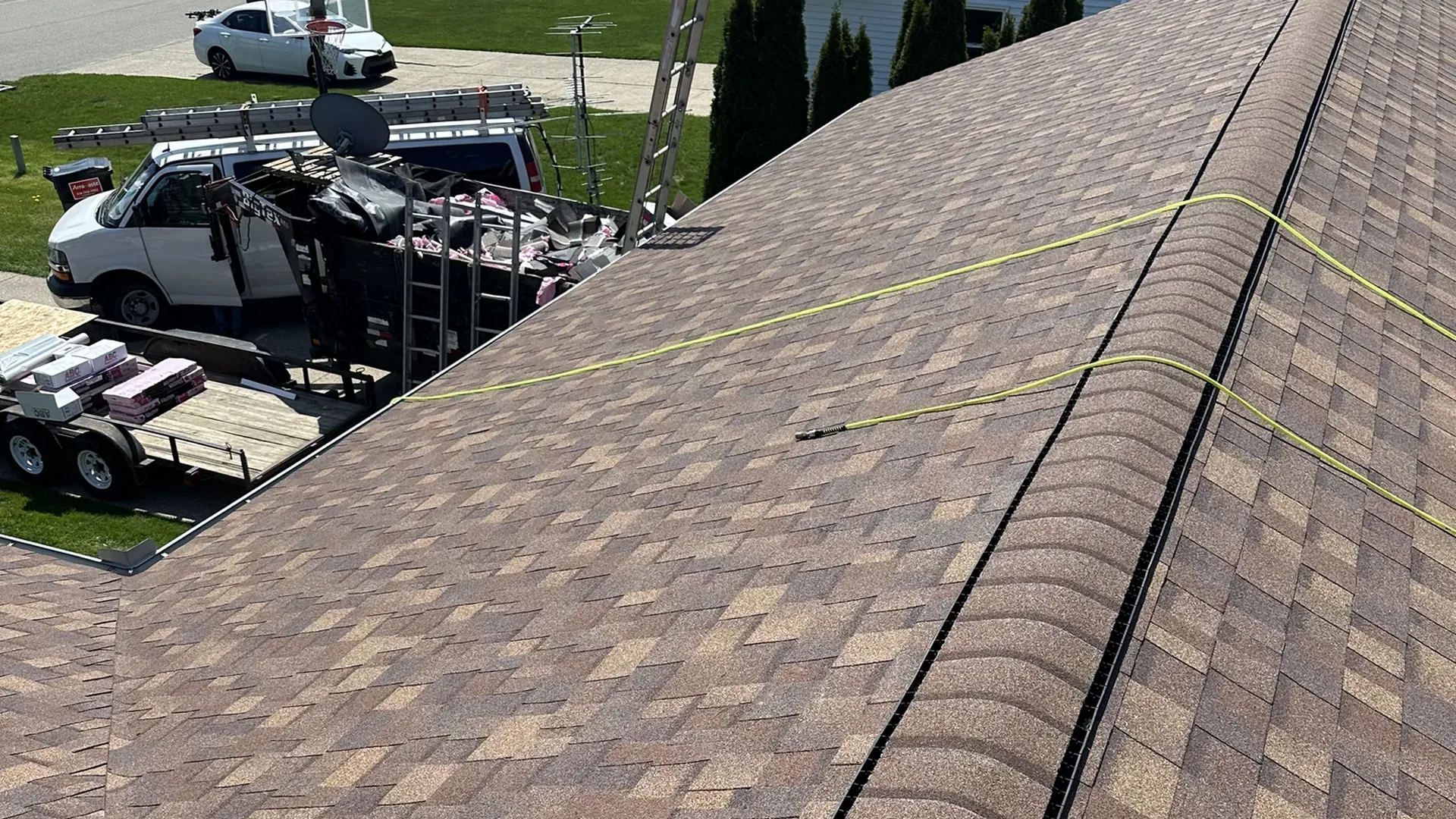
The top line of an asphalt roof takes direct sun, wind, rain, and snow while covering one of the assembly's most important transitions. When a ridge cap cracks, lifts, or disappears, the opening below may be much larger than the missing piece suggests.
Ridge trouble is not one diagnosis. The visible problem may be a damaged cap shingle, failed fastener, separated vent, worn end detail, or movement in the decking or framing. The repair should identify which layer failed before new material covers it.
What Makes Up the Roof Ridge
A ridge is where two opposing roof slopes meet. The roof deck and underlayment approach that line from both sides. A roof with continuous ridge ventilation has a planned slot near the peak, a manufactured vent centered over it, and cap shingles installed above the vent. A roof without a ridge vent still needs a compatible cap detail over the peak.
Hips also use cap shingles, but a hip runs diagonally from an outside corner toward a higher point. It normally does not serve as an attic exhaust opening. An inspection record should distinguish the ridge from the hips because the layers and possible water paths differ.
A ridge vent is part of a ventilation path
The vent gives warmer, moisture-laden attic air an exhaust route near the peak. It needs suitable intake lower on the roof and a clear attic air path. Adding more exhaust does not correct blocked soffit intake or air leaking from the house.
Ridge Cap Shingles Protect a High-Stress Joint
Ridge caps bend across an angle and overlap in one direction along the peak. Their fastening and exposure are different from the shingle courses on the flat part of a slope. Purpose-made caps also need to match the roof system and any vent beneath them.
Problems begin when a cap is cracked through the bend, fastened in the wrong place, left with an exposed nail, or installed with too little overlap. A loose leading edge can catch wind. Repeated motion then enlarges fastener holes, tears the mat, and disturbs the cap beside it. Our guide to nail pops and exposed fasteners explains why covering a metal head alone does not restore attachment.
The Vent Beneath the Caps Also Needs Inspection
A ridge vent should sit centered and secure over its opening. Its end pieces, joints, external baffles, and fastening points help keep the exhaust path open while limiting wind-driven water and debris. Crushed, split, lifted, or displaced vent sections can change both weather protection and airflow.
Not every ridge leak comes through the vent. Water may enter around a missing cap, a face nail, an open end, or damaged underlayment. Condensation can also wet the underside of the deck when indoor moisture and cold surfaces meet. Check roof evidence and attic conditions together instead of blaming the nearest vent. The attic ventilation guide covers the relationship between intake and exhaust.
Warning Signs You Can See From the Ground
- ●A gap or dark section in an otherwise continuous cap line
- ●One cap sitting higher than the pieces beside it
- ●A folded, cracked, or missing end near a rake edge
- ●Exposed fastener heads or sealant patches along the peak
- ●A vent section that looks wavy, separated, or visible below the caps
- ●Shingle pieces in the yard that have a pronounced bend through the middle
Use binoculars or a zoomed photo from a stable location. Do not climb to the peak to press on a loose cap. The ridge is usually the least accessible part of the roof, and a damaged shingle may tear under a hand or foot.
Check the Attic and the Ceiling Below
Inside an accessible attic, inspect the deck and framing near the peak for dark staining, damp wood, rusted fastener tips, daylight, matted insulation, or frost. Note whether the pattern is confined to one point, follows the ridge slot, or extends down a rafter. Do not assume every dark mark is active moisture.
A ceiling stain may appear below the ridge or farther downslope after water follows the deck or framing. Record the room, time, recent weather, and outside roof area before finishes dry. The steps in our guide to documenting a roof leak help preserve that pattern for the inspection.
What a Lasting Ridge Repair Should Address
- 01Map every damaged or loose cap and compare it with the surrounding ridge and hip details.
- 02Remove enough material to inspect the vent, underlayment, deck edge, and fastening below the failed area.
- 03Repair weak decking or displaced vent sections before installing replacement caps.
- 04Use compatible ridge materials, overlaps, fasteners, and end details from the written roof-system instructions.
- 05Photograph the opened area and completed repair so the concealed work stays with the roof record.
Smearing roof cement across the peak can hide the condition without restoring the shingle mat, vent alignment, or deck attachment. A temporary weather measure should remain identifiable and should not block the intended exhaust path.
A Focused Repair May Be Enough
A few damaged caps can support a focused repair when matching material is available and the nearby roof remains flexible and serviceable. Widespread cap cracking, brittle field shingles, repeated wind loss, soft decking, or movement along the whole peak requires a broader evaluation. A ridge that dips or changes shape may involve more than the roof covering. Compare those conditions with our guide to wavy and sagging rooflines before choosing the scope.
Frequently Asked Questions
Are ridge cap shingles different from regular roof shingles?
Yes. Ridge cap shingles are made or prepared to cover the angle where roof slopes meet. Their exposure, fastening pattern, overlap, and compatible vent details should follow the written instructions for the roof system rather than being improvised from leftover material.
Does every asphalt roof have a ridge vent?
No. Some roofs use a continuous ridge vent, while others use box vents, off-ridge vents, gable vents, or a different designed system. Exhaust should be evaluated with the attic intake and the rest of the ventilation layout before vents are added or removed.
How urgent is a missing ridge cap shingle?
A missing cap can expose fasteners, the ridge vent, underlayment, or a roof-deck opening. Keep people off the roof, document the area from a safe location, and arrange prompt inspection, especially when rain or snow can reach the opening.
Can roof cement fix a loose ridge cap?
Roof cement may cover a small surface opening temporarily, but it does not restore a torn shingle, weak fastening, displaced vent, or damaged deck. A lasting repair identifies the failed layer and restores compatible overlaps and attachment.
Does ridge damage mean the whole roof needs replacement?
Not automatically. A focused repair may be reasonable when damage is isolated and the surrounding roof remains serviceable. Widespread brittle shingles, repeated ridge loss, deteriorated decking, or several failing roof areas can support a larger scope.
Get the Peak Checked Before the Opening Spreads
Platinum Roofing inspects ridge caps, vents, fasteners, decking, and related leak paths across Grand Rapids, Jenison, Holland, Muskegon, Kalamazoo, and nearby West Michigan communities. Call or text (616) 256-0831 to schedule a free roof assessment.